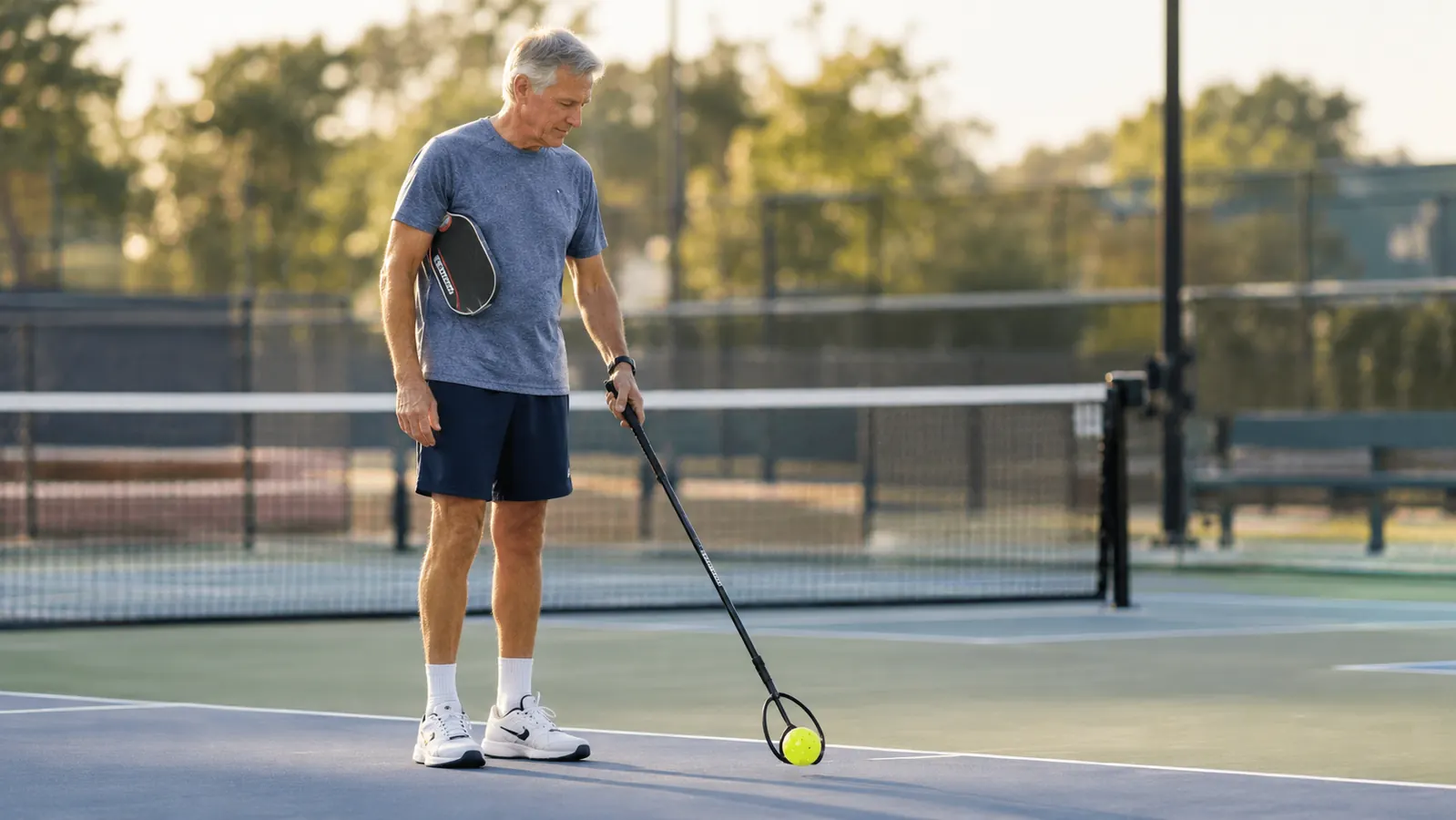
The first time I used a ball retriever, I felt a little silly. Here I was, a 64-year-old retired civil engineer who spent thirty years reading spec sheets, standing at the baseline of a city park court with what looked like a short stick with a scoop on the end. Then I played a full morning of doubles without bending over once, and my right knee, the one I had scoped years ago, felt the same at noon as it did at nine. That sold me. The QOGIR Pickleball Ball Retriever is not the most exciting piece of gear I own. It might be the most useful.
I ordered one after a month of watching players twice my age bend, wince, and bend again during warmups. My wife Linda and I play four or five mornings a week, mostly doubles, at the city park courts, or indoors at the rec center when it rains. A typical drill session puts thirty or forty balls on the court. Pick them up one at a time and you have just volunteered for forty deep knee bends before the first real point of the day. The QOGIR retriever is supposed to fix that. After six weeks of daily use, here is what I can tell you, including the parts the product page leaves out.
The Quick Verdict
A cheap, clever tool that genuinely saves your back and knees, with a fit quirk and a few fiddly moments you should know about before you buy.
Amazon Check Today's Price →My Back Stopped Complaining by Noon. Yours Can Too.
The QOGIR retriever is inexpensive, light, and it lives in my bag full time. It has quirks, and I list every one of them below. If the tradeoff sounds fair, check today's price on Amazon.
Amazon Check Today's Price on Amazon →How I've Used It
I have used the retriever every playing day for six weeks, which works out to somewhere north of forty sessions. That includes outdoor park courts with a light wind, indoor rec center floors, and a few sessions on the driveway net I set up when I want to drill alone. I use it for three jobs: picking up balls after a drill, scooping the handful of balls that roll onto the next court during doubles, and clearing the area near the kitchen line between games without asking my knees to do the work.
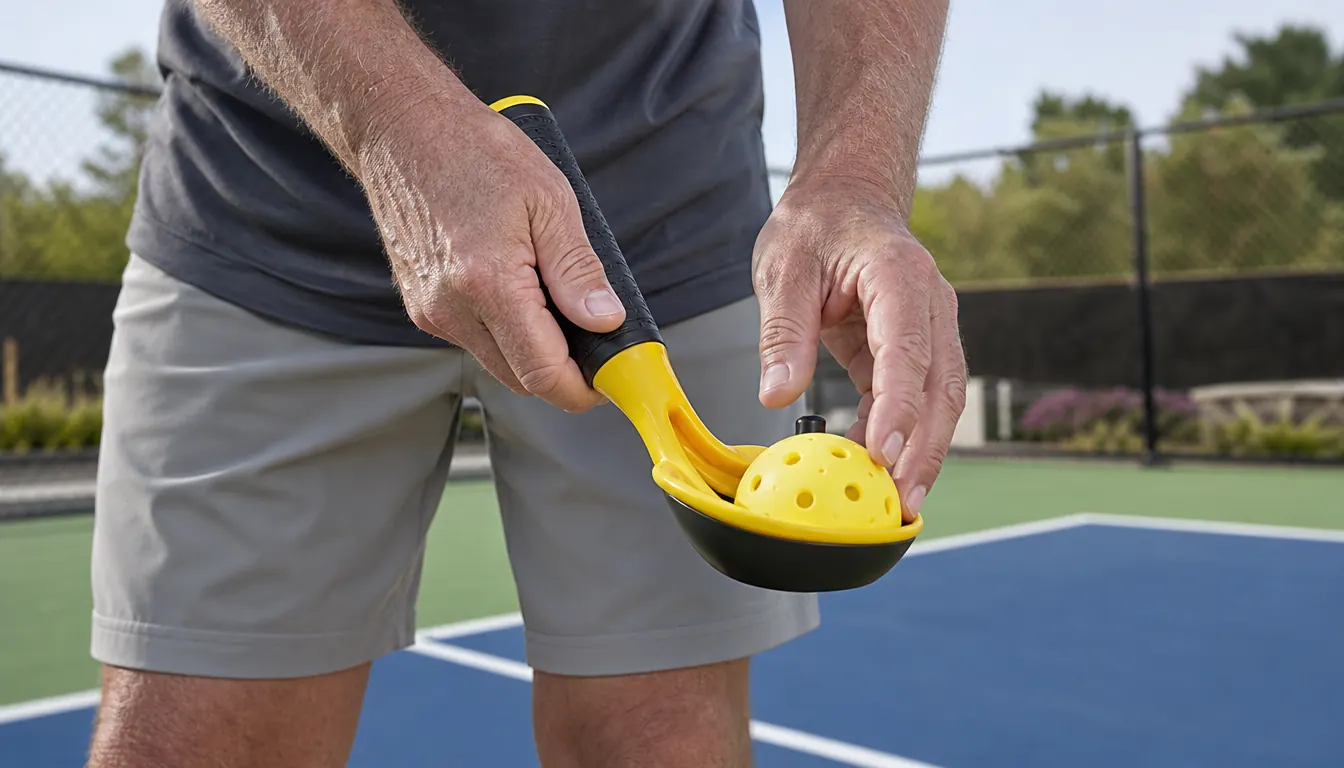
The motion is easy to learn. You hold the retriever in your dominant hand, place the head over a ball, and push down with a little angle. The ball seats into the head, you lift, and it drops into your other hand or straight into the ball basket. Once the motion clicks, it takes about two seconds per ball. The first few times, I pushed too hard and the ball shot out sideways. You do not need force. You need a light touch and the right angle, and that takes about ten minutes of practice.
The real test is picking balls off the ground one-handed while holding your paddle in the other. During a quick changeover in doubles, you often have one ball in your hand, your paddle under your arm, and two balls on the ground near your feet. The retriever lets you grab both without setting anything down. That is the moment it stops feeling like a gadget and starts feeling like a tool. On mornings when I drill alone on the driveway net, I use the retriever constantly. I hit twenty balls, then scoop them all up in under a minute, then hit them again. Without it, I would spend a third of the session bent over. With it, the whole drill is footwork and contact, and I finish before my coffee gets cold.
First Impressions: What Arrives and What You Do With It
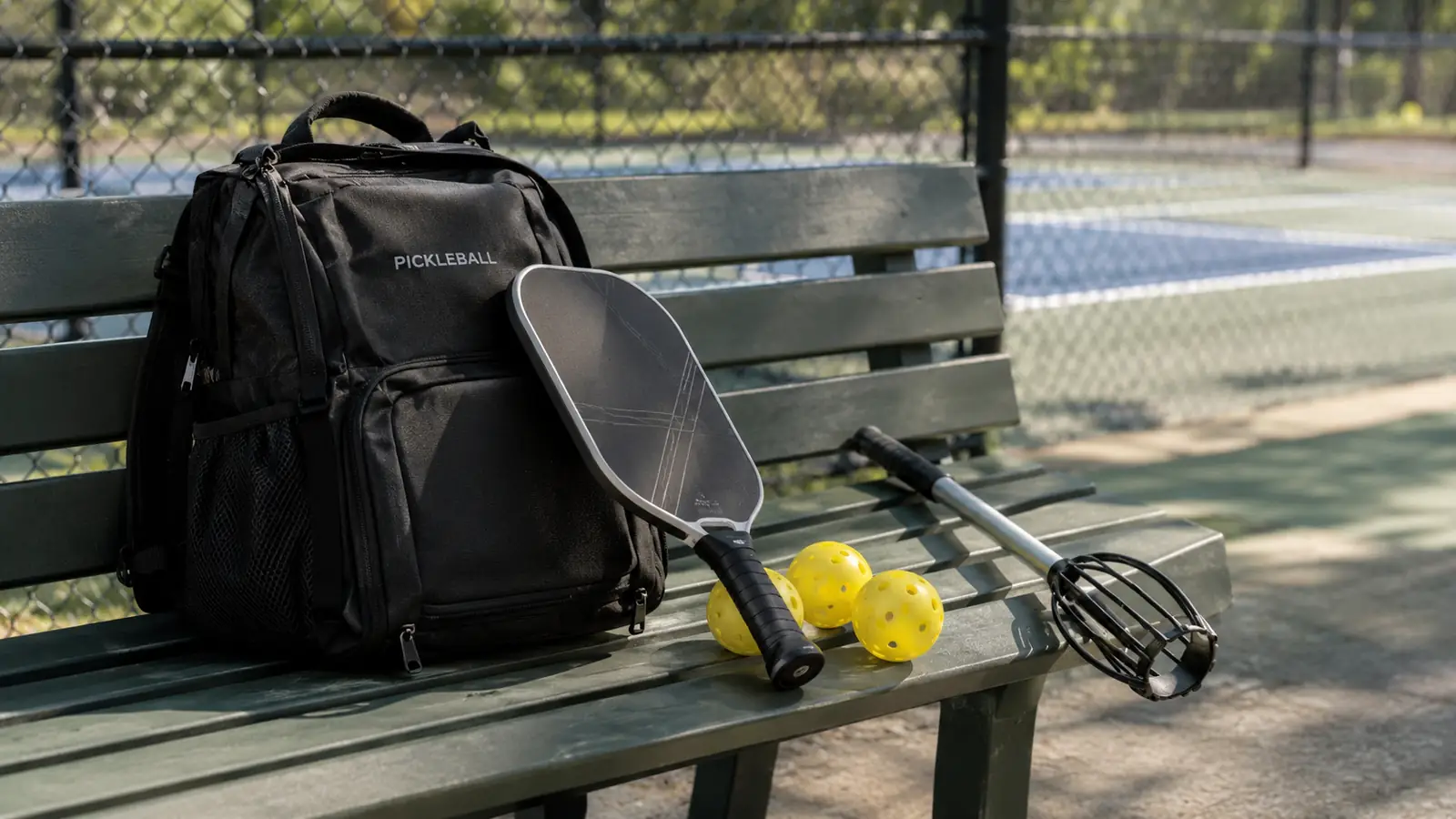
The retriever arrived in a simple package with no surprises. It is one piece, a handle with a scooping head, plus a grip that slides over the handle of your paddle. That last detail is the clever part. Because the retriever stores on your paddle, it is always with you. You do not have to remember to grab it from your bag between games, and you do not have to walk back to the bench to get it.
Setup took me about a minute. Slide the grip over the handle of my main paddle, push it up until it sits out of the way, and it was ready. The first time I swung with it on, I noticed a tiny bit of extra weight up top, and I adjusted my grip out of habit. By the second session, I did not think about it at all. That is the best thing I can say about any piece of gear: it disappears.
One thing I appreciate is that there is no assembly. Some gear arrives as a pile of parts and a diagram that assumes you have a degree in mechanical engineering. This arrived ready to use. Slide the grip, grab a ball, done. For a guy who has assembled enough backyard gear to last two lifetimes, that counts for a lot.
What Nobody Tells You: The 'Fits Any Paddle' Claim Needs a Footnote
The product title says it fits any paddle. That is mostly true, with a footnote. The retriever stores over the handle of your paddle, so the grip opening has to be wide enough to slide over the handle. On my main paddle, a standard model with a round handle, it slides on easily and stays put. On Linda's paddle, which has a slightly flared grip, it goes on with a bit of persuasion and sits a little looser. It has not fallen off during a game, but I check it before I swing, and I have learned to give it a half twist to seat it. That half twist is the kind of detail you only figure out by using the thing.
The fiddly part is that the fit depends on your handle shape, and nobody tells you that until you try it. If your paddle has a thick butt cap or an octagonal handle, the retriever may sit crooked, and a crooked retriever makes an odd noise when you swing. It will not hurt your paddle. It is just annoying, and it will make you take it off between points, which is the opposite of convenient.
My advice is to try it on your paddle the day it arrives, not the morning of a game. If it fits your handle well, it will become permanent. If it sits crooked, you still have a perfectly good retriever. You just have to store it in your bag instead of on your paddle, and that is a small tradeoff for the back savings.
Where It Earns Its Keep
The honest case for this thing is simple: it turns forty bends into zero. I counted the balls in one of my driveway drill sessions, thirty-eight. Without the retriever, that is thirty-eight bends before I have even started the drill. With it, I stand at the kitchen line, scoop, drop, scoop, drop, and my back never gets involved. For a guy with a scoped knee and a mild case of tennis elbow, that is the whole ballgame.
It is also light. I barely notice it in my bag. It does not add meaningful weight, it does not snag on the zipper, and it takes up less room than a water bottle. When the rec center lets out and the courts are crowded, I can clear a cluster of balls from our court in under a minute without walking to the fence line and back for each one. That matters more than it sounds, because a crowded rec center means every minute between games is a minute someone else is waiting for the court.
It is built simply enough that there is not much to break. A handle, a head, a grip. I have dropped it on asphalt, left it in the car on a hot day, and knocked it against the fence more times than I can count. It still works. The grip has not stretched out, the head has not warped, and the joint between the handle and the head is as solid as the day it arrived. The only wear is cosmetic, a few scuffs on the head from dragging across the court when I set it down. I cannot say the same for every retriever design I have tried.
I will also say this: it has changed how I warm up. I used to arrive early to hit a few balls and then spend the first ten minutes of play feeling my back loosen up. Now I can spend that time actually playing. For a recreational player, that is the whole reason to own one. It does not make you hit better. It makes you feel better when the game is over, and that keeps you coming back the next morning.
I counted thirty-eight balls in one drill session. With the retriever, that is thirty-eight bends I never had to make.
Where It Slows You Down
Now the part the reviews do not tell you. The retriever is slower than bending over when you only need one ball. If a single ball rolls to your feet during a point, the fastest move is still to pick it up with your hand. By the time you locate the retriever, seat the ball, and lift, you have spent the same two seconds, and you have done it with a piece of gear in your hand. I use the retriever for volume, not for singles.
It also struggles with balls that are wedged. A ball sitting flat in the open is easy. A ball pushed against the fence, or tucked into the corner where the court meets the post, will not seat cleanly into the head. You end up nudging it with your foot or reaching down after all. The same goes for a wet ball. The head grabs a dry ball cleanly; a wet ball can slip out on the way up. That is a small thing until it happens at 8:15 in the morning and you are still on your first cup of coffee.
The other slowdown is social. In doubles, you do not want to be the player walking across the court with a stick while your partner waits at the line. I have learned to use it at changeovers and between games, not mid-point. That is a rhythm thing, not a product flaw, but it is real, and nobody puts it in the description.
If I were the designer, I would make the grip a touch narrower and add a small locking ring so the retriever sits tighter on a flared handle. I would also round the edge of the head slightly, because on a hard indoor floor the flat edge can catch and skip when you are in a hurry. And I would offer a high-visibility color option, because I have set the retriever down on the court and then spent ten seconds looking for it. These are small things. They do not change my recommendation. They are the difference between a product that is good and one that is great.
How It Compares to the Tube-Style Retrievers
I have also spent time with the tube-style retrievers, the ones that look like a long cylinder you roll over the ball. They work, and they are satisfying when you get the roll right. But they are bulkier in the bag, and the ones I have tried have a hinge and a spring that get finicky over time. The QOGIR design has none of that. There is no hinge, no spring, no mechanism to wear out. The tradeoff is that you have to aim the head at the ball, which takes a little more attention than rolling a tube over it.
For my money, the aiming is worth it. I would rather spend two seconds aiming than carry a bigger piece of gear and wonder when the spring is going to give out. If you already own a tube-style retriever and it works for you, keep it. If you are choosing between the two, the QOGIR is the one I reach for every morning.
One more thing worth noting: the QOGIR works with both indoor and outdoor balls. Some retrievers I have tried are picky about ball texture. I have used this one with the smooth indoor balls at the rec center and the rougher outdoor balls at the park, and it grabs both the same way. That matters if you play in different places during the week like I do.
What I Liked
- Turns a forty-ball pickup into zero bends, which is the whole point
- Light and compact, easy to keep in your bag full time
- Simple design with nothing to break or wear out
- Fits most standard paddle handles and stores on the paddle
- Fast enough for volume pickups between games and after drills
Where It Falls Short
- The fits any paddle claim is generous; flared or thick handles sit looser
- Slower than bending for a single ball, so it is a volume tool
- Struggles with wedged or wet balls
- The head can skip on hard indoor floors when you rush
Who This Is For
Buy this if you are the player who picks up the balls. That is the whole test. If you drill on your own, if you clear the court between games, if you are the one who walks the fence line collecting strays while everyone else talks, this tool will save your back, your knees, or both. It is also a natural fit for anyone over fifty who plays regularly and wants to keep playing without paying for it the next morning. My right knee thanked me within the first week, and my back stopped complaining by noon. Linda, who is not quick to adopt gear, started borrowing mine by the second week and has since asked me to order a second one so she does not have to share. That is the strongest endorsement I can offer.
Who Should Skip It
Skip it if you only play organized games where someone else handles the balls, or if you play once a week and pick up a handful of balls each time. At that volume, the retriever is a solution looking for a problem. Skip it too if you have a paddle with a very thick or oddly shaped handle and you refuse to store the retriever in your bag instead of on the paddle. The fit quirk will annoy you out of using it, and an unused retriever is just a stick in your trunk. There is no shame in that. It just means this particular tool is not built for your routine.
The Simplest Way to Protect Your Back on the Court
Six weeks in, the QOGIR retriever is a permanent part of my bag. It is inexpensive, it works, and it has a couple of quirks you now know about before you buy. If that sounds like a fair trade, check today's price on Amazon.
Amazon Check Today's Price on Amazon →