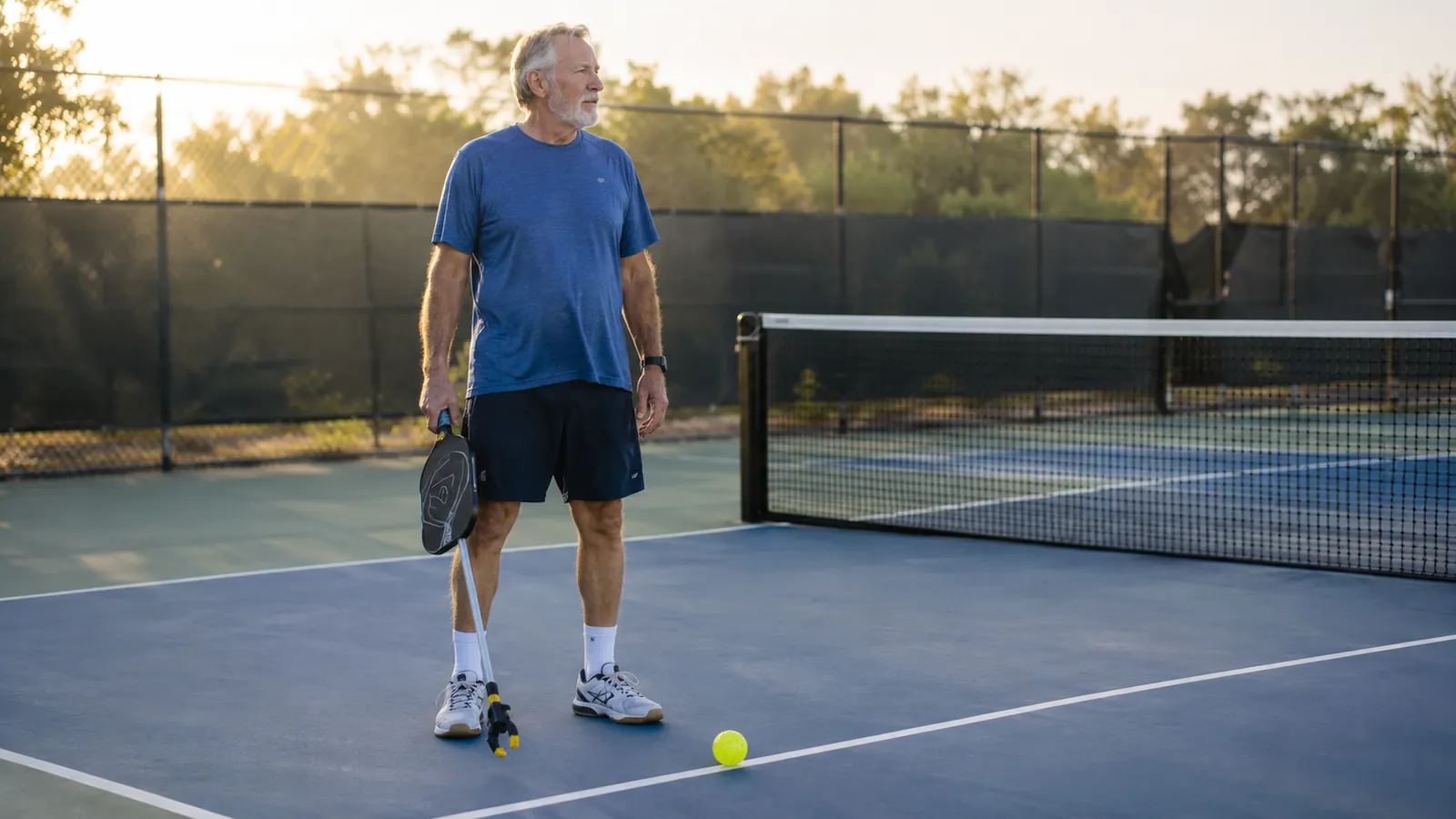
Pickleball has a hidden cost that has nothing to do with spin rates or grip size. It is the bending. In a typical hour of doubles, I bend down to pick up a ball forty or more times. Each bend is easy. The fortieth one is not. My right knee was scoped years ago, and after a long morning it keeps a precise count of how many times I reached for a ball instead of letting a retriever do the work.
The QOGIR retriever is a simple tool that clips onto your paddle. You press the open end over a ball, and it grabs the ball without you leaning over. That sounds too simple to matter. It has mattered more to my knees than any paddle upgrade I have bought in five years of playing.
I am not going to tell you the retriever changed my game. It did not. I still miss easy shots and I still lose more doubles than I win. What it changed is the morning after. I used to wake up stiff on the days I played. Now the stiffness is gone, and I stopped reaching for the ibuprofen bottle after the Tuesday session.
Save your knees the forty bends you did last match.
The QOGIR retriever clips onto any paddle and picks up a ball without you bending. It takes about ten minutes to learn the motion, and it works with the paddle you already own.
Amazon Check Today's Price on Amazon →Why I Started Using One
I resisted these things for a year. They looked like a gadget, and I told myself that bending was part of the game. Then a doubles partner pointed out that I was favoring my right knee by the third game, and that favoring it was changing my footwork. I was playing worse, not because of my hands or my eyes, but because I was quietly protecting a knee. That is a stupid way to lose points.
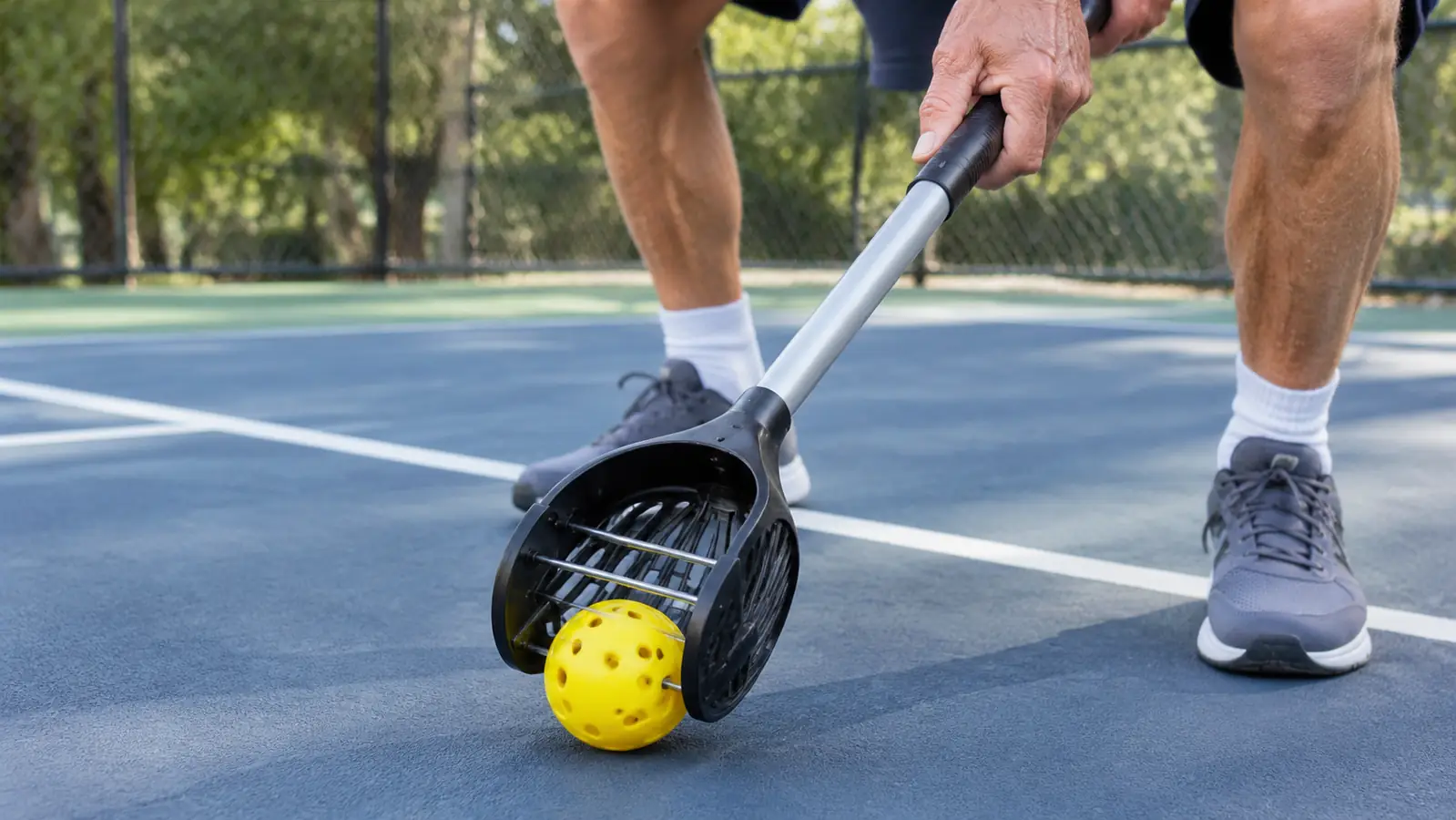
The QOGIR attaches to the end of my paddle handle and stays there for the whole session. I do not have to think about it. When a ball stops near me, I press the retriever over it, lift, and hand the ball to my partner or toss it back to the other side. The motion takes about two seconds, and it does not require me to take my eyes off the next serve.
The Five Steps That Worked for Me
Step 1: Attach It to Your Paddle Before You Leave the House
The QOGIR slides onto the end of your paddle handle. Do this at home the first time, not on the court. You want to feel how far it needs to seat before it feels solid, because a loose retriever twists the moment you press down on a ball, and a twisted retriever misses the ball entirely.
I keep a second QOGIR in the pocket of my bag. The first one has been on the same paddle for months, but the clip can wear, and a spare is easy to carry. If you play both outdoor park courts and an indoor rec center like I do, the spare means a broken retriever never costs you a morning of play.
One note: check the fit before you trust it in a game. The retriever should sit snug enough that you can press it over a ball on the kitchen floor at home without it sliding up the handle. If it slides, seat it deeper. That two-minute check saves you from fumbling during a rally.
Step 2: Learn the Angle Before You Learn the Speed
The mistake almost everyone makes on the first day is jabbing straight down at the ball. Straight down works on a perfectly flat court, and courts are rarely perfectly flat. Approach the ball from the side at a slight angle, press the rim of the retriever over the top of the ball, and let it seat. The ball pops in cleanly.
On the outdoor courts where I play, the surface has small cracks and a few loose pebbles near the fence line. A straight jab pushes the ball sideways. The angled press traps it. Spend five minutes at home rolling a ball on a hard floor and practicing the angle, because muscle memory from the kitchen transfers straight to the court.
This is also the step where you learn what the retriever will not do. It will not pick up a ball that is rolling fast. You still stop the ball with your foot or your paddle, then press. Once I accepted that, I stopped fighting the tool and started using it the way it was designed.
Step 3: Use It in Live Play Without Slowing the Game
The worry most players have is that a retriever slows the game down. It does the opposite if you use it the way I do. When a point ends, I walk toward my position and pick up any ball on my side on the way. One smooth press, one lift, and I toss the ball to the server or roll it to the fence. I never stop walking.
In doubles, the rhythm matters more than the individual motion. My wife Linda and I play most mornings, and we have a simple rule: the player who is not serving picks up the strays. With the retriever on my paddle, that job takes one hand and two seconds. Without it, I would be bending over between every point, and my knee would be complaining by the third game.
One small habit makes this work in open play: pick up the ball on your side of the court, not the far side. You are not the ball boy. You are protecting your own space, and the retriever makes that a one-step job instead of a stretch and a bend.
Step 4: Build It Into Your Between-Point Routine
The retriever only helps if it is in your hand when the ball stops. That sounds obvious, but I watched players leave theirs in the bag after the first week. Make it part of the routine: after every point, scan your side, press, lift, toss. Do that for a week and you stop thinking about it entirely.
Here is the math that convinced me. A typical doubles session has four or five games. Each game has maybe eight points. That is roughly forty balls a session, and most of them stop near someone. At forty bends a session and four sessions a week, I was asking my right knee to do about 160 bends a week just to keep the court tidy. The retriever took almost all of them away.
I count this as the step that saved the most wear. The first three steps are about learning the tool. This one is about building the habit, and the habit is what protects your joints on the days you do not think about your joints at all.
Step 5: Drill With It So the Motion Becomes Automatic
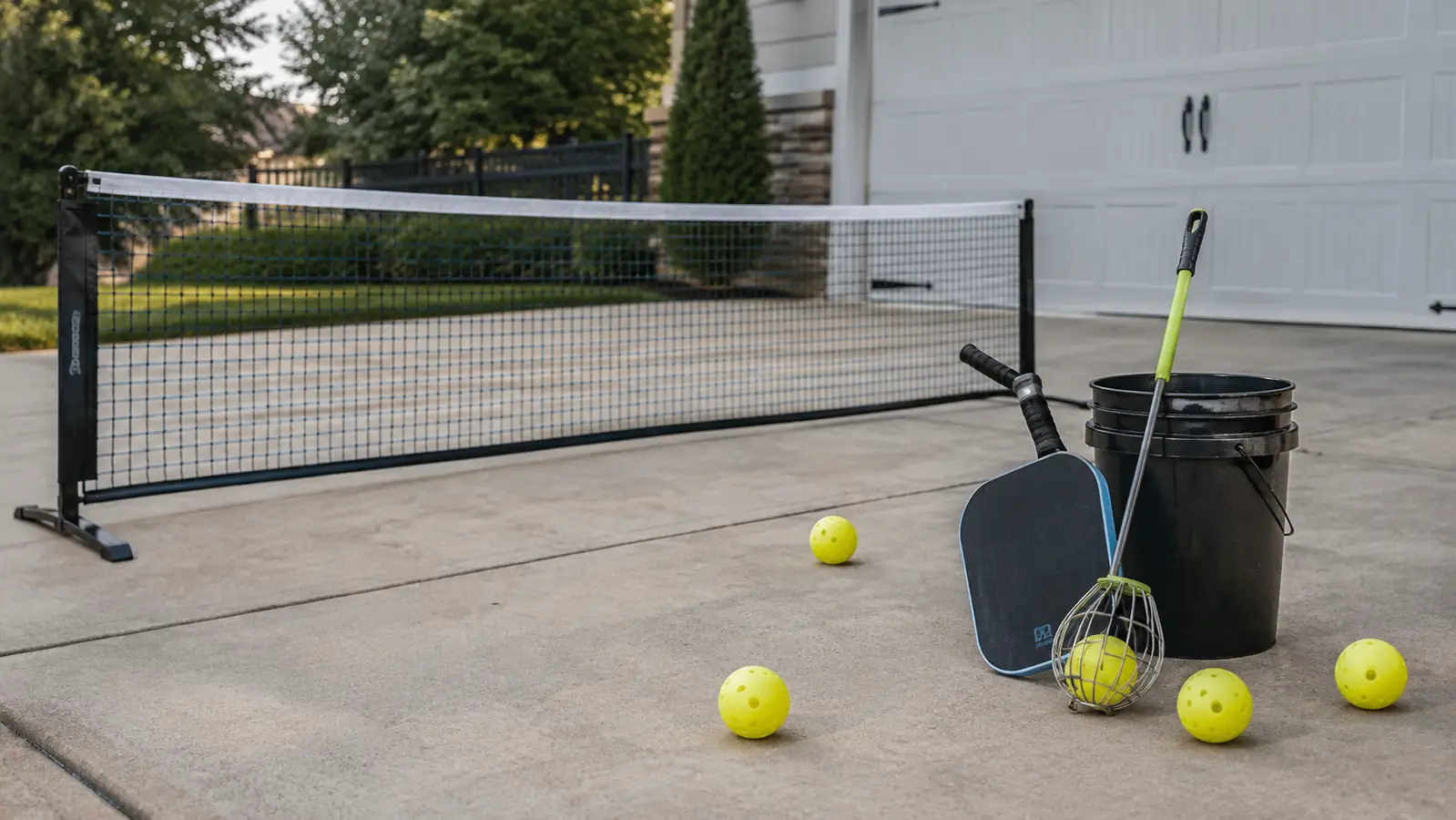
I practice in my driveway, where I keep a portable net set up for solo work. The drill is simple: scatter ten balls on the concrete, pick them up one at a time with the retriever, and place them in a bucket. Then scatter them again and do it faster. Ten minutes, three times a week.
The point is not speed for its own sake. The point is that the press-and-lift motion becomes something your hand does without your brain. When it is automatic, you will use the retriever in a real game without missing a beat, and you will use it at the end of a long morning when your legs are tired and your form would otherwise go sloppy.
If you only do one drill, do this one. It takes less time than a warm-up, and it is the closest thing I have found to a guarantee that the retriever will actually be in your hand when a ball stops near you next match.
What About the Alternatives?
Before I bought the QOGIR, I tried the obvious alternatives. Bending over was free, and it was wearing me out. A ball hopper tube does the same job, but it is a separate piece of gear you have to carry to the court and set down between points. The retriever lives on my paddle, which means it is always where I need it, and it never gets left in the car.
The other alternative is just accepting the bend, and that is a legitimate choice for players in their forties. I am not in my forties. My right knee was scoped years ago, and I would rather carry a small piece of plastic on my paddle than spend the next season favoring one leg. That is the whole calculation.
What the QOGIR Won't Do
I want to be straight about the limits. The retriever will not pick up a ball that is moving, it will not help you reach a ball that is under the fence, and it will not fix a serve that is already off. It is a tool for one specific job: getting a stationary ball off the ground without bending. That one job is worth a lot to me, but it is not everything.
There is also a small learning curve on uneven surfaces. On grass or loose courts, the ball can squirt sideways when you press. You learn to press a little slower and a little more vertical. After a week it stops being a problem, but I would rather tell you now than have you think you bought a defective one on day one.
What Else Helps
The retriever does the bending for you, but it does not do everything. I pair it with a knee sleeve on my right knee for the first game of the morning, and I stretch my calves before I walk onto the court. Linda swears by a five-minute warm-up with the paddle before the first serve. None of that is fancy. It just means the retriever is one part of a routine that keeps me playing four mornings a week instead of watching from a chair.
If you play on outdoor courts, a small mesh bag for balls helps too. I keep six balls in the car, and the retriever means I can collect them from the court without a single bend. It sounds like a small thing. It is the difference between picking up balls because you are done playing and picking them up because your back is already tired.
Roughly 160 bends a week is what the retriever took off my right knee, and my knee noticed within two weeks.
The Bottom Line
The bottom line is simple. If you play pickleball more than once a week and you are over fifty, the bending is the part of the game that will catch up with you first. The QOGIR retriever does not make you a better player. It makes you a player who can still move well on Thursday after playing Tuesday, and at my age that is the same thing.
If you are shopping for one, the QOGIR is the model I have used for months and the one I would buy again. It fits the paddle I already owned, it takes up no space in my bag, and it has held up to daily use. I cannot promise it will do the same for you. I can tell you it solved the exact problem I bought it for.
Ten minutes of practice now saves you forty bends next match.
The QOGIR retriever fits any paddle, takes about ten minutes to learn, and stays on your paddle for the whole session. If you play more than twice a week, your knees will notice the difference by the end of the month.
Amazon Check Today's Price on Amazon →