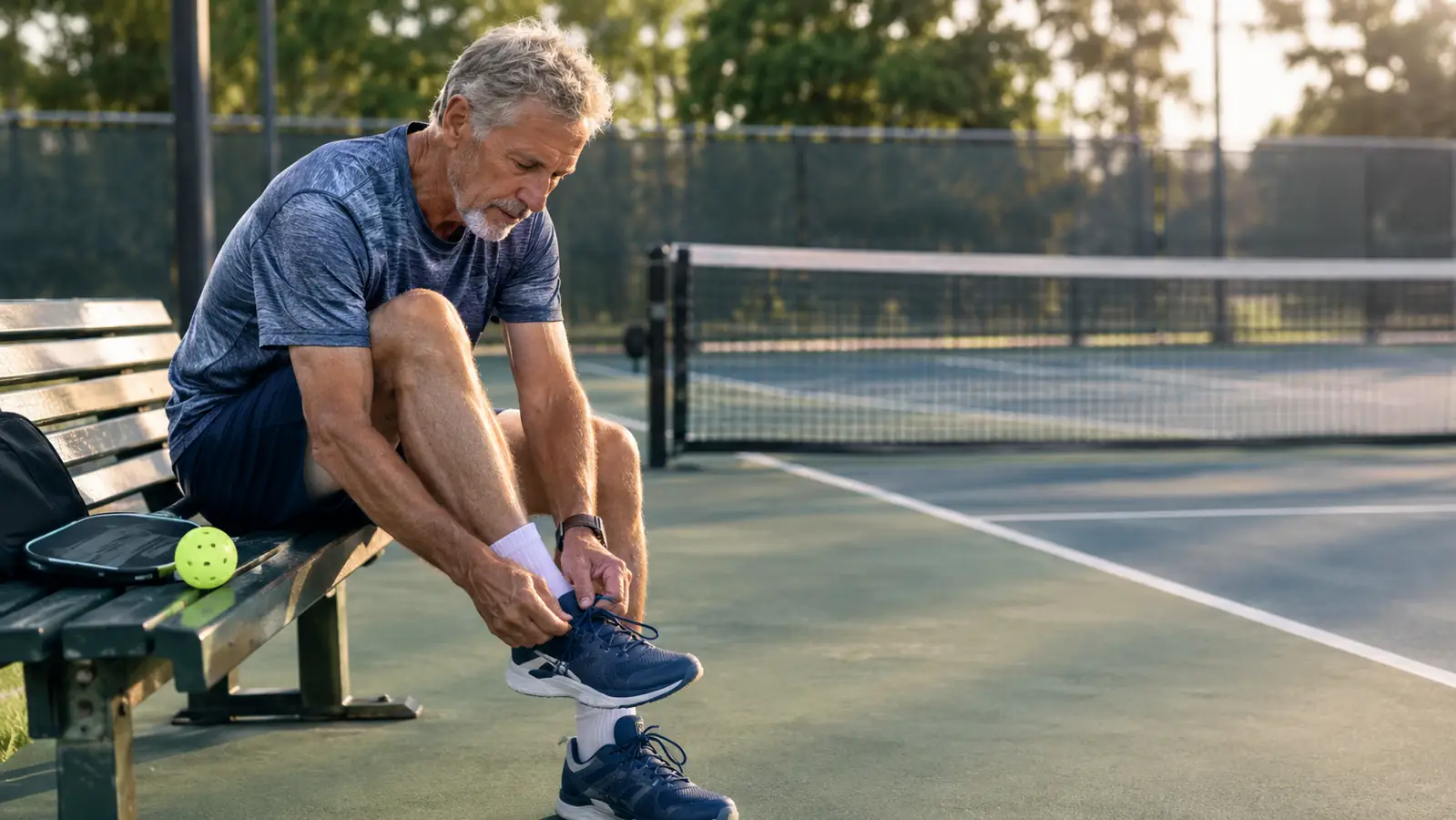
If you are over 50 and your knees complain after a morning of doubles, the shoes are usually the first thing to fix, not the last. I am Gene, I am 64, I had my right knee scoped years ago, and I have spent the last five years learning what court shoes actually do for older players. This guide walks through the five checks I run before I buy anything, using the ASICS Gel-Dedicate 8 as the benchmark. You can use the same steps with any pair you are considering.
The mistake most of us make is buying a running shoe because it feels soft in the store. Soft feels great for five minutes. After an hour of quick side steps, a running shoe lets your foot roll over the edge, and that roll goes straight up into the knee. Court shoes are built differently for a reason. Here is how to check whether a pair will actually protect your knees, step by step.
Start with a court shoe built for lateral moves, not a running shoe
The ASICS Gel-Dedicate 8 is the pair I keep coming back to for outdoor doubles. It is stable, it grips the court, and it does not cost what most court shoes cost. Check today's price on Amazon to see where it lands.
Amazon Check Today's Price on Amazon →Step 1: Check the heel lockdown before you even lace up
Put the shoe on and leave the laces loose. Push your foot forward so your toes touch the end. Now slide your index finger behind your heel. If you cannot get the finger in, the shoe is too short. If you can get two fingers in, it is too long. You want about a thumb's width of space at the toe, and a heel that does not lift when you walk.
Heel slip is the quiet knee killer. Every time your heel lifts inside the shoe, your foot slides forward, and your knee has to catch the motion on the next step. Do this a few hundred times a session and you have a recipe for a sore knee the next morning. The ASICS Gel-Dedicate 8 has a padded collar that holds the heel in place, which is one of the main reasons it works for older players.
If you are between sizes, go up. Court shoes do not stretch much, and a cramped toe box causes more problems than a half size that feels roomy at first.
Let me give you a concrete example. Last October I ordered a pair of court shoes a half size down because the store was out of my size and I was impatient. The toe felt fine in the store, but by the second morning of doubles at the park courts my right foot was numb by the end of the first game. I checked the fit the way I described above: I pushed my foot forward and tried to slide a finger behind my heel. I could barely get a fingernail in. The shoe was about a quarter inch too short, and that quarter inch was pressing right on the ball of my foot. I returned them and went up a half size. The lesson stuck: a court shoe that is even slightly short will cause more foot and knee trouble than a shoe that feels a little roomy in the store. My right knee, the one I had scoped in my early fifties, always lets me know within a day when the fit is wrong, so I trust that signal now. I also learned to do this check later in the day, because feet swell as the day goes on, and a shoe that fits first thing in the morning can pinch by the time you play an evening session.
Step 2: Test the lateral support with your hand, not your feet
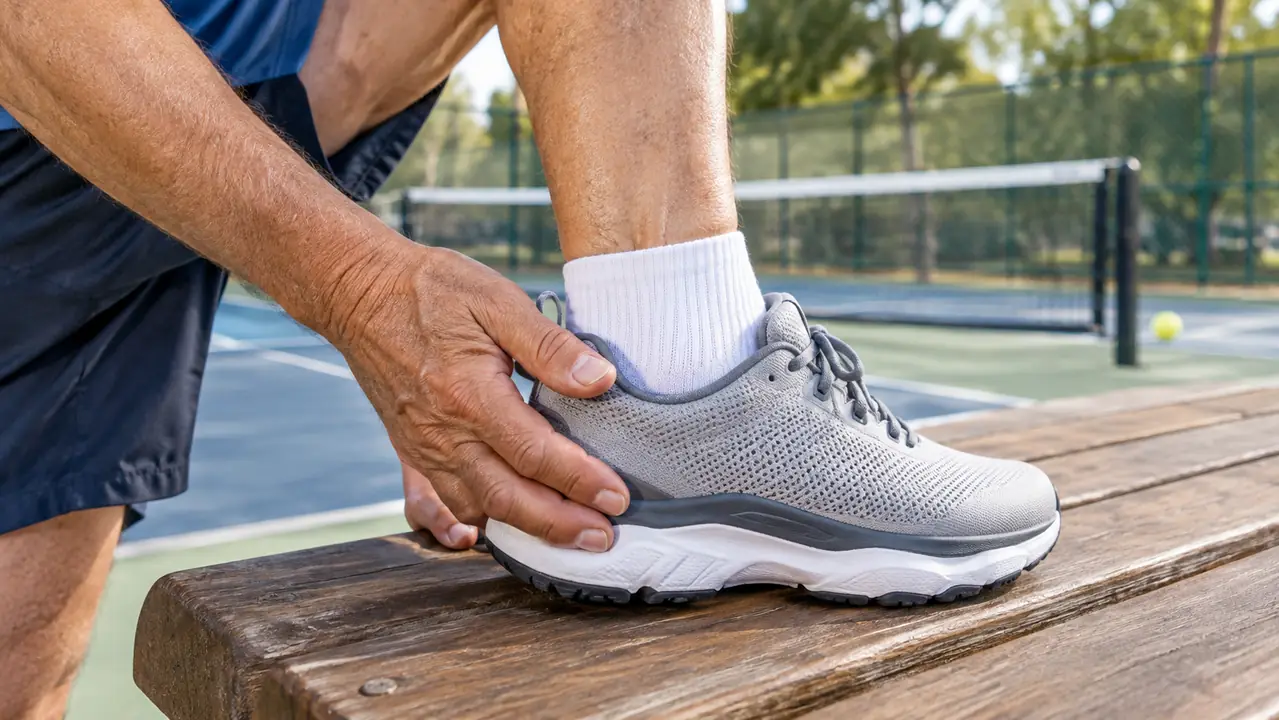
Hold the shoe in one hand and press hard against the outside of the heel with the other. A court shoe should resist that pressure. If the side collapses easily, your foot will roll outward when you plant and push off, and that roll is exactly what aggravates a knee that has already been scoped.
This is the single biggest difference between a court shoe and a running shoe. Running is a straight-line sport. Pickleball is a lateral sport. You are constantly stepping left, stepping right, and stopping on a dime. The shoe needs a stiff heel counter and a firm midsole to keep your foot from rolling over the edge. The ASICS Gel-Dedicate 8 has a reinforced heel and a stable platform that I trust on outdoor courts.
Do this test on both shoes, because manufacturing variance is real. If one side feels softer than the other, that pair is not for you.
I learned this test the hard way. About three years ago I bought a popular running shoe because a friend swore by the cushioning. The cushioning was real. The lateral support was not. I could press the side of the heel in with one thumb, which did not seem to matter until the first time I planted hard to chase a cross-court dink. My foot rolled over the outside edge, my knee twisted, and I limped for the rest of the week. That afternoon I went back to the store, pressed on the heel counters of every court shoe on the rack, and bought the pair that resisted the hardest. The ASICS Gel-Dedicate 8 passed that same hand test in the store, and it still passes it today, months later. If a shoe fails the hand test in the store, no amount of break-in will fix it, because the stiffness comes from the heel counter molded into the shoe, not from the upper breaking in. I run the same test on Linda's shoes before she buys, and it has saved her from two pairs that looked great and folded like paper when pressed.
Step 3: Look at the outsole pattern before you look at the color
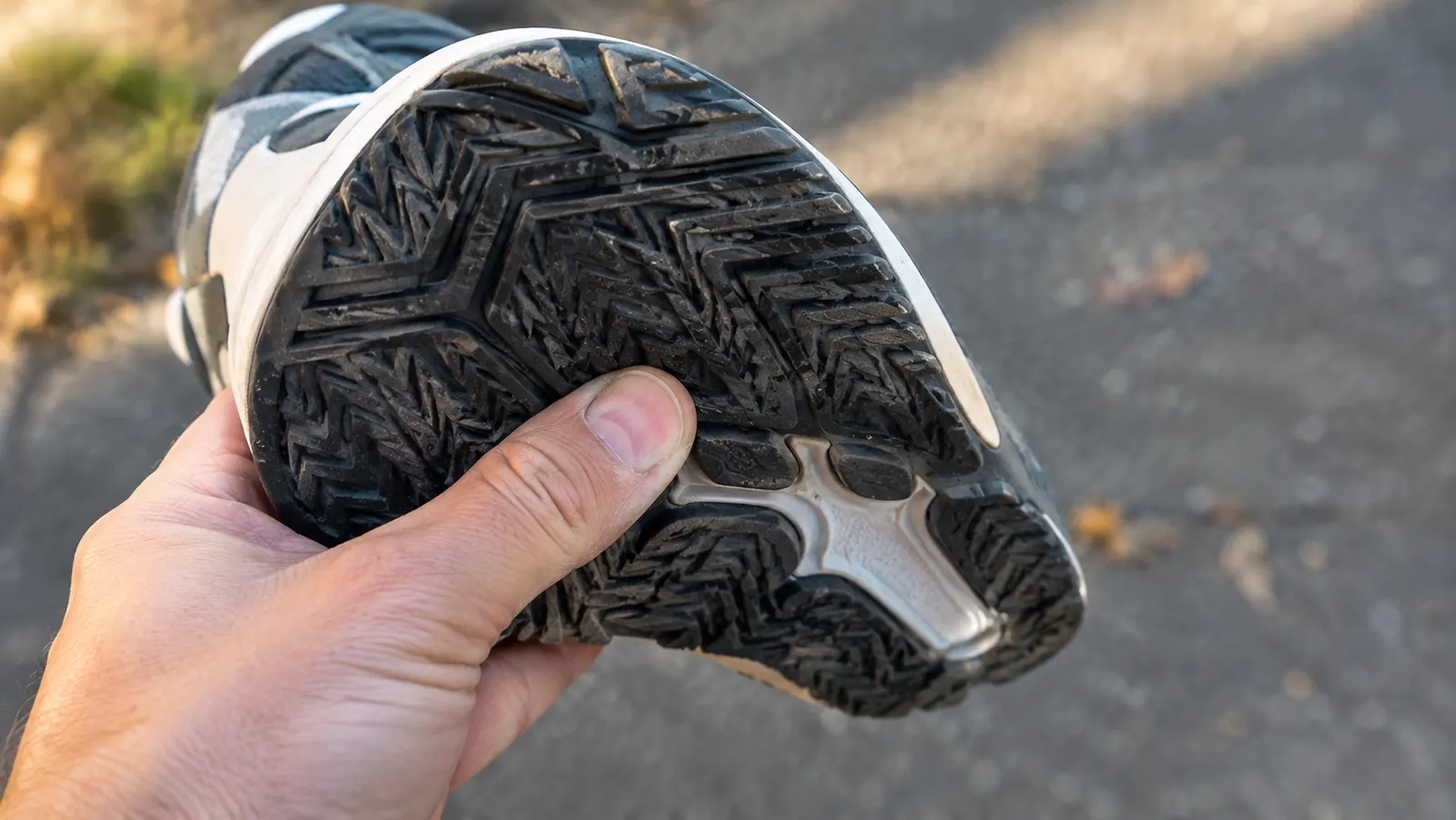
Turn the shoe over and look at the tread. You want a pattern that grips the court surface, with solid rubber in the areas where you plant your foot: the ball of the foot and the outside edge of the heel. A shoe with a mostly smooth outsole will slide when you make a quick direction change, and a slide is a fast way to twist a knee.
The ASICS Gel-Dedicate 8 uses a rubber outsole with a tread pattern designed for court surfaces. It grips indoor wood and outdoor painted hard courts about the same, which matters if you play at the rec center when it rains and the park courts when it is dry, like I do.
A quick note on traction: too much grip can also be a problem on some indoor surfaces. If you feel like your foot is sticking and twisting, that is a surface issue, not necessarily a shoe issue. Try a different court before you give up on the shoe.
Here is a specific example of why I check tread before color now. In January we had a stretch of rain, so Linda and I played three straight mornings on the indoor courts at the rec center. My old shoes, which still looked fine on top, slid on the first hard cut of the first game. I caught myself with my left hand on the floor and felt the pull in my right knee. When I turned the shoe over, the outsole was smooth in the exact spot where I plant: the outside edge of the heel. The tread had worn down over about ten months of outdoor play, and I had not noticed because the uppers looked almost new. I replaced them that week. Now I check the outsole every few weeks, and I look at the ball of the foot and the outside heel edge first, because those are the two spots that tell you the truth about how you move. A shoe can look fine on the rack and still be done on the court, and the bottom of the shoe never lies the way the top can.
Step 4: Walk the lacing pattern, then lock it down
Most court shoes come with a standard lacing pattern, but you can adjust it to fit your foot. If you have a narrow heel like I do, use the extra eyelet at the top and create a heel lock. Lace normally up to the second-to-last eyelet, then cross the lace through the top eyelet on the same side to form a loop, then cross through the opposite loop and pull tight. This locks the heel down without squeezing the toe box.
The ASICS Gel-Dedicate 8 has a traditional lacing system that is easy to adjust. I use a heel lock on mine and it makes a noticeable difference in how stable my knee feels during a long session of doubles.
If you wear orthotics or a knee sleeve, bring them to the store and try the shoe on with them. A shoe that fits perfectly without a sleeve can feel tight with one. The Gel-Dedicate 8 has a removable insole, which makes it easier to fit orthotics.
Step 5: Check the wear pattern after a month, not a year
Most of us replace court shoes too late. I used to play until the outsole was smooth, which meant I was playing on shoes that had lost their lateral support for months. Now I check the outsole every few weeks. Look at the outside edge of the heel and the ball of the foot. If you can see the midsole through the tread, it is time to start shopping.
The ASICS Gel-Dedicate 8 has a durable rubber outsole that holds up well on outdoor courts. I have had my pair for about eight months of regular play and they still have solid tread. That durability is one of the reasons I recommend them to friends who play as often as I do.
A good rule of thumb: if you play three or more times a week, plan to replace your court shoes every six to nine months. If you play once a week, you can stretch that to a year or more. Your knees are worth the cost of a fresh pair.
To put a number on it, I keep a small notebook in my gear bag. I wrote the date I bought the ASICS Gel-Dedicate 8 on the inside of the tongue with a permanent marker: March 3. About eight months in, in early November, I measured the tread with a cheap tread-depth gauge I picked up at an auto parts store. The rest of the outsole still looked fine, but the outside heel edge read about half of what it read when the shoes were new. That is the number I use now: when the outside heel edge loses half its depth, I start shopping. On my current pair, that was right around the seven-month mark of playing four mornings a week. If you play less, you will get more time out of a pair. But the habit matters more than the calendar. Checking the outsole on the first of every month takes ten seconds and has saved me from two bad months of playing on worn shoes. The same gauge works for the ball of the foot, and I check both spots every time.
What Else Helps
Shoes are the foundation, but they are not the whole answer. A knee sleeve adds compression and warmth, which helps my scoped knee on cold mornings. Stretching your calves and hips before you play takes five minutes and reduces the load on your knees. And if you play on hard courts, consider a shoe with a slightly thicker midsole for shock absorption. The ASICS Gel-Dedicate 8 has a gel unit in the heel that absorbs impact on hard surfaces, which is a nice feature for older players.
The ASICS Gel-Dedicate 8 held my heel in place through eight months of outdoor doubles, and my knee felt better the morning after than it did with the running shoes I used to wear.
Give your knees a fresh start with a court shoe that fits
The ASICS Gel-Dedicate 8 is a solid choice for players over 50 who want lateral support without breaking the bank. Check today's price on Amazon and see if it is the right fit for your game.
Amazon Check Today's Price on Amazon →