
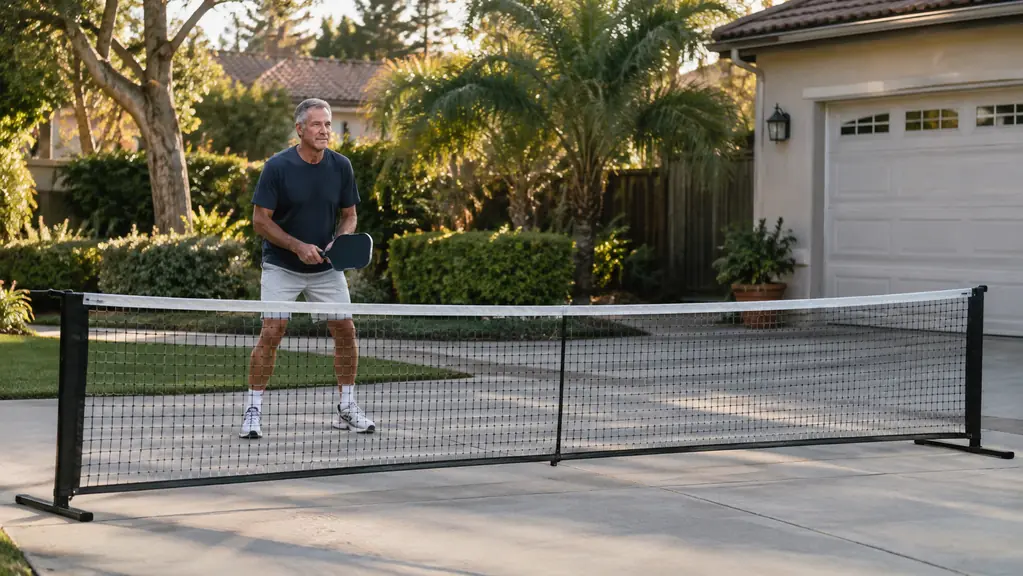
I bought the A11N SPORTS portable pickleball net last spring for one simple reason: I wanted to drill on my driveway without asking Linda to come shag balls every time. Six months later, the net is still up more mornings than not, and that tells me more than any spec sheet. I bought it with my own money, and nobody from the company has ever contacted me, so there is no reason to sugarcoat any of this. But a season of daily use has also taught me things the product photos do not show. The wind limits. The frame joints that need a second look. The way the net sags if you tension it wrong. Those are the things I want to talk about today, because they are the difference between loving this net and being annoyed by it.
Quick background so you know where I am coming from. I am Gene, 64, a retired civil engineer in Santa Rosa, California. I switched from tennis to pickleball about five years ago when a neighbor talked me into a Saturday clinic, and now I play four or five mornings a week, mostly doubles at the city park courts, indoors at the rec center when it rains. My right knee was scoped years ago, so I care about gear that does not fight me. I am not a coach and I do not sell gear. I am just the guy who reads the spec sheets so his friends do not have to. This review is about whether the A11N net holds up for a player like me, not for a college athlete.
The Quick Verdict
A regulation-size net with a steadier frame than I expected, held back by wind sensitivity and a carrying bag that is tighter than it needs to be. For driveway drilling, it earns its spot.
Amazon Check Today's Price →The short version, in case you are in a hurry
The A11N SPORTS net is the one I reach for on practice mornings. It sets up in about ten minutes, holds a full 22-foot width, and has survived a season of my worst forehands. It is not perfect, and I get into the details below. Check today's price on Amazon to see whether it fits your setup.
Amazon Check Today's Price on Amazon →How I've Used It
My setup is a two-car driveway with a slight slope, which turns out to matter more than I expected. I set the A11N net across the far end, facing the garage, and hit into it from the kitchen line. The slope means I have to check that the feet are level before I start, or the ball comes back at a funny angle. Most mornings I run through a hundred or so shots: dinks, third-shot drops, the occasional forehand I should not be proud of. The net catches everything, which is the whole point of owning one.
I have used it roughly three hundred times since last spring, in sun, fog, and the kind of wind that makes the neighbor's wind chimes sing. I keep it up for days at a time in good weather and take it down when the forecast gets serious. I keep a small notebook in the garage and jot down what I worked on, which sounds fussy but has honestly made me a steadier player. The entry from March 14, for example, says third-shot drops, 80 reps, net held steady, knee fine afterward. That routine, up and down, is where you learn a product's real character, because the daily friction is what decides whether you actually use the thing. I can tell you the exact morning the routine clicked: a Tuesday in late April, foggy, when I set it up in eight minutes flat and got through a hundred balls without once chasing one into the street. On a court, a bad hit means a jog to the fence. On the driveway, the net sends the ball right back, and that changes how many reps you are willing to take.
I also brought it to the park courts twice so a friend could practice serves, and it handled being moved in a car and set up on grass. So my notes cover driveway use, park use, and a fair amount of plain abuse. Nothing has broken, which is more than I can say for the cheaper net a neighbor bought the same month.
What Nobody Tells You About Wind
Here is the first thing nobody tells you: the A11N SPORTS net is a sail. The PE netting is dense enough to stop a ball cold, which is what you want, but that same density catches wind like a bedsheet on a clothesline. On a calm morning it is rock solid. On a gusty one, you will know within thirty seconds. In a steady breeze over about ten miles an hour, the top bar starts to flex and the whole frame wants to walk across the driveway.
I learned this the hard way on the morning of April 19. I had left the net up overnight because I was lazy, a front moved through around six, and when I came out with my coffee I found the frame tipped sideways against Linda's car. The top bar had caught the passenger mirror. No damage, but it was a close call, and the net had dragged two of the four stakes out of the ground on its way over. The included stakes help, and I use them every time now, but they are short, maybe five inches of bite, and they pull out of dry soil easily. I checked the weather station app that morning: gusts to 23 miles an hour. Anything over ten and I take the net down, or I add the sandbags before I walk away.
The honest fix is simple: take the net down when you are done, or add a couple of sandbags to the feet. I use two old sandbags from the hardware store and the net does not move. That is not a design failure so much as a fact of any portable net this size. But I wish the manual said it plainly instead of showing a calm, sunny photo.
The Frame and the Net: What Holds Up
The frame is the part I worried about most, because I have seen cheap portable nets fold at the joints after one season. The A11N SPORTS uses a steel frame with a powder-coated finish, and the joints are the kind that lock with a push-button pin. After six months of regular setup, all the pins still click, and none of the tubes have bent.
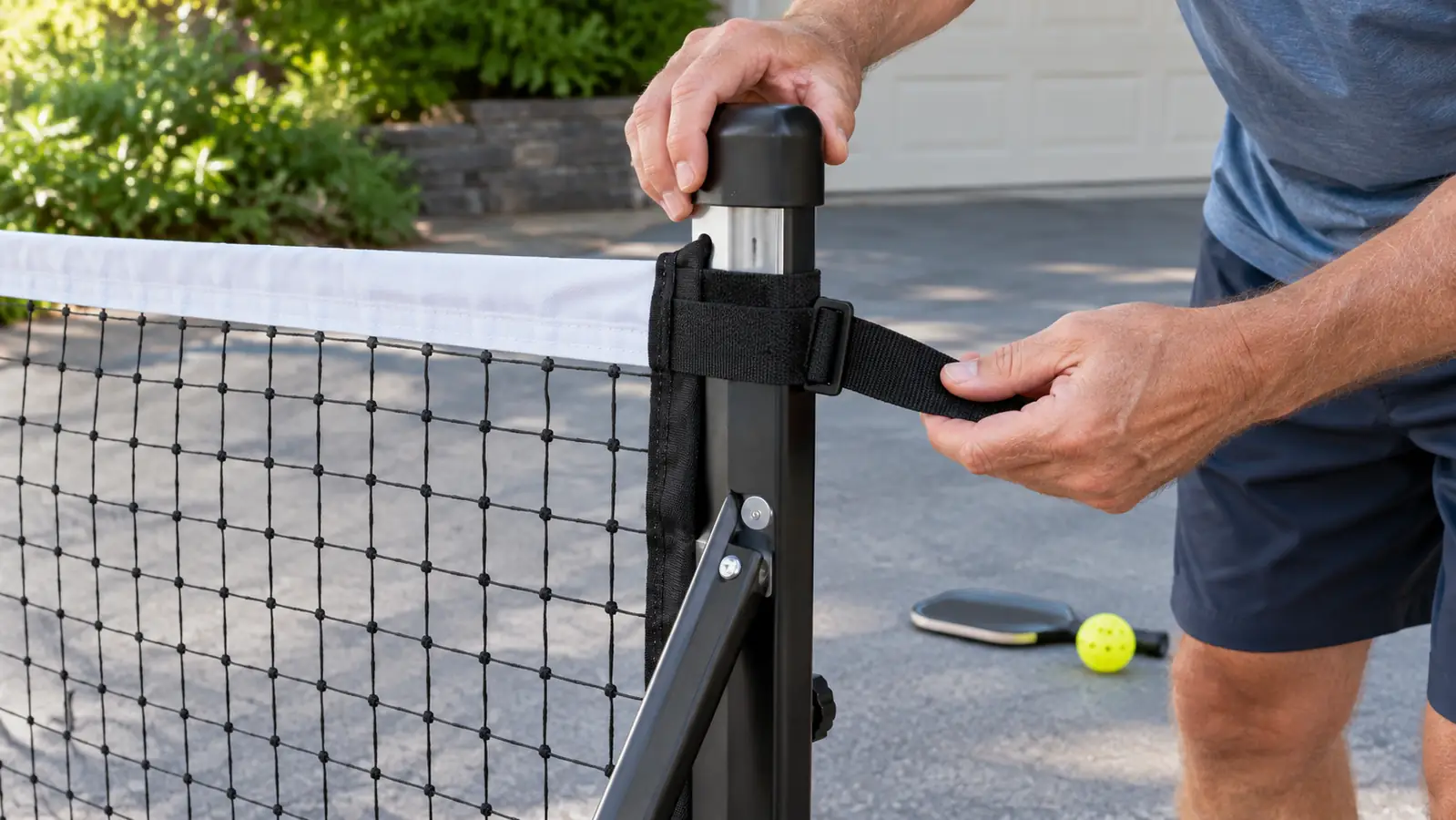
The netting itself has held up better than I expected. I hit hard, and I have put more balls into the same spot on the lower third than I can count, maybe two hundred into a patch the size of a dinner plate. There is one small area, about the size of my hand, where the weave has stretched a bit and the ball comes back with less pop, but there are no tears and no frayed edges. The tension straps on the sides do most of the work, and they are the first thing I check before a session. If I leave the net up overnight, the straps need a half turn each in the morning, because the netting relaxes as it sits. It takes ten seconds and it keeps the middle tight.
One thing to know: the net is regulation size, 22 feet wide and 36 inches tall, exactly what the listing says. I measured it once with a tape measure, because I did not trust the listing. It was right, within half an inch on the width. That matters for practicing shot placement, because the target is the same size you face on a real court. The height feels a touch low when you are standing close, and at the kitchen line the top edge sits just below my chest, so a lobbed reset ball clears it. That is standard for this style of portable net, but it is worth knowing before you buy.
Three small details are worth knowing. The base feet grip the driveway well, which is why the net does not slide when you hit a low ball, even on the slope near the garage. The top bar has a slight curve that keeps the net from sagging in the middle, and that curve is the first thing I check after a windy night, because a sagging middle changes where the ball comes back. And the whole thing weighs less than I expected, which makes it easy to move but also means it needs those stakes. I weighed it once on the bathroom scale, holding it, and subtracted my own weight: right around 19 pounds.
The netting has held up better than I expected. One small stretch, no tears, after six months of daily drilling.
The Carrying Bag and Setup Routine
Setup takes me about ten minutes now, and about fifteen the first time. The frame comes in three main sections that click together, then the net slides onto the top bar, then you tension the sides and stake the feet. The instructions are mostly pictures, which is fine once you have done it once, and a little confusing the first time.
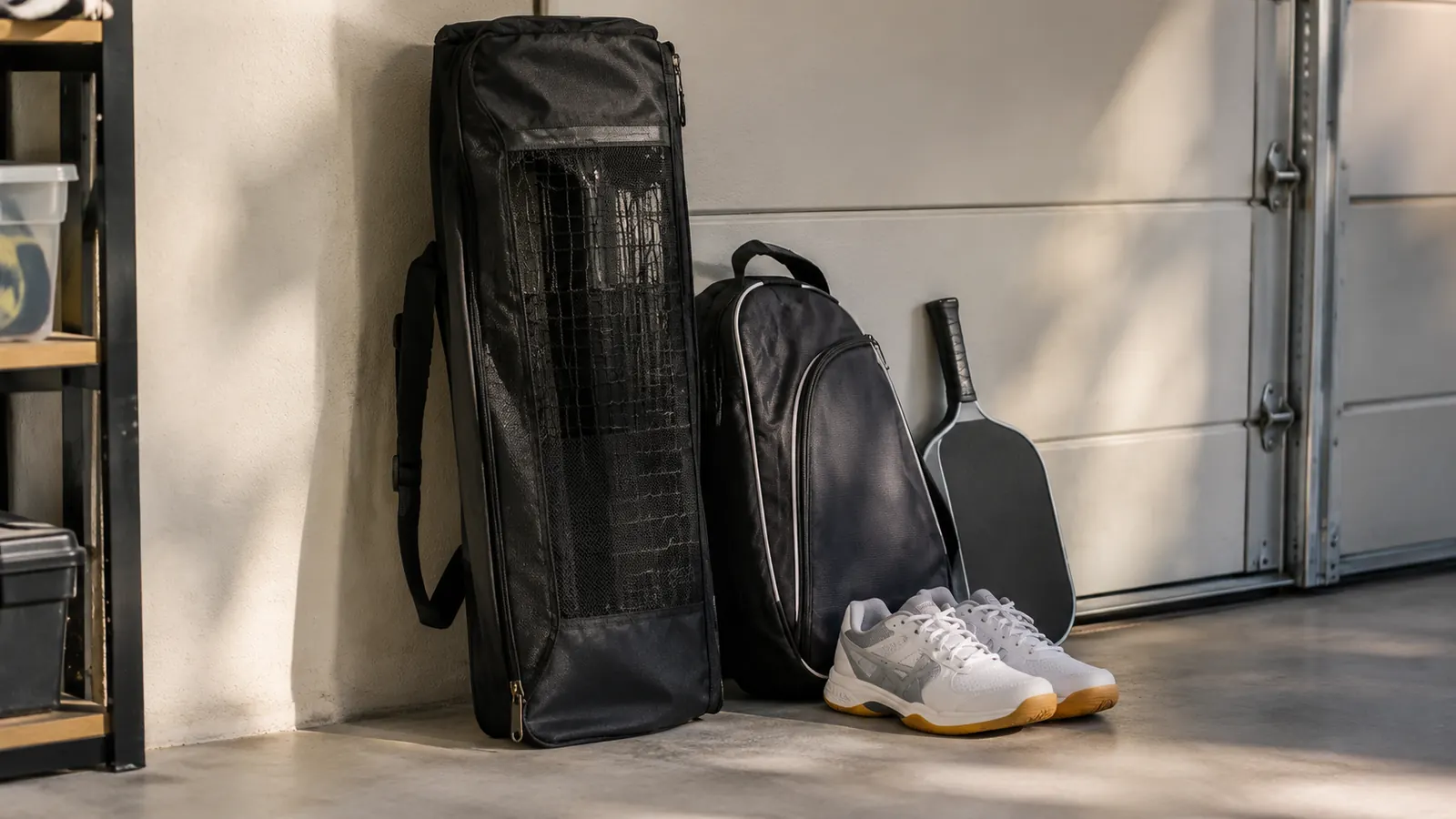
The carrying bag is the weakest part of the package. It is a basic nylon bag with a single zipper that runs most of the way around, and it fits the frame and net only if you fold everything just right. I have wrestled with it enough that I now leave the net assembled in the garage when the weather is good. That is not a dealbreaker, but it is the first thing I would change.
What I'd Change and the Alternatives I Considered
If I could redesign one thing, it would be the bag. A wider opening and a second zipper pull would make it a lot easier to live with. The second thing is the stakes. They work, but they are on the short side, and on hard or dry ground they bend before they bite. I replaced mine with longer tent stakes from the camping bin, and that solved the problem. I would also like a slightly taller net for practicing resets and overhead shots. At 36 inches, the top edge is about chest height on me, so high balls sail over. I understand why it is that height, for portability and storage, but it is a real limit for certain drills.
Before I settled on the A11N SPORTS, I looked at a couple of cheaper portable nets and one heavier permanent frame. The cheaper nets saved money but had thinner frames, and one of them was only 14 feet wide, which defeated the purpose of practicing on a regulation-size target. The permanent frame was sturdier, but it took up half the garage, needed to be bolted to the wall, and cost considerably more. My neighbor, the one who bought the cheaper net the same month I bought mine, had his top bar bend in the first big windstorm of the season. His net still works, but it sags in the middle now, and he has to aim low to keep balls from going over. That comparison, sitting right next door, is the reason I would not trade the A11N for the savings.
I also considered a freestanding rebounder style, but those are built for quick returns, not for realistic ball flight, and the good ones cost more than the A11N. For what I wanted, a regulation-size net with a solid frame was the right call, and the A11N was the best balance of price, weight, and build I found. Your driveway and your priorities may point somewhere else, which is fine. The point of this section is not to sell you on my choice. It is to save you the three weeks I spent comparing listings and reading reviews before I clicked buy.
What I Liked
- Regulation 22-foot width makes practice shots realistic
- Steel frame has held up through six months of daily setup
- Netting shows no tears despite a lot of hard hitting
- Folds into a bag that fits in a sedan trunk
- Sets up in about ten minutes once you learn the routine
Where It Falls Short
- Catches wind like a sail and needs stakes or added weight
- Carrying bag is tight and fussy to pack
- 36-inch height lets high balls sail over
- Included stakes are short and bend on hard ground
Who This Is For
Buy the A11N SPORTS net if you have a driveway, a garage, or a flat patch of yard and you want to practice without a partner. It is ideal for players over 50 who want reps on a regulation-size target without driving to the courts every day. The best part is that I can stop when my knee tells me to, without letting a partner down. If you are coming back from a knee scope like me, being able to take fifty controlled shots at your own pace is genuinely useful.
It is also a good fit if you want something you can take to the park or a friend's house. The whole thing folds into the bag and fits in the trunk of a sedan. That portability is the main reason it beats a permanent wall-mounted net for most people.
Who Should Skip It
Skip it if you live somewhere genuinely windy, unless you are willing to stake it down or add weight every single time. Skip it if you mostly want to practice high balls and resets, because the 36-inch height will frustrate you. And skip it if you expect zero assembly fuss, because the bag and the setup routine require a little patience. That last one is not a criticism of the product. It is just a warning about who should not buy it.
None of that makes it a bad net. It just means it is a tool with limits, like every tool. The honest version of this review is that the A11N SPORTS net does its main job very well, and the things it does poorly are things you can work around once you know they are there.
My honest bottom line
After six months and a few hundred practice sessions, the A11N SPORTS net is still the first thing I set up on a good morning. It is not perfect, and the wind and the bag will test your patience. But for driveway drilling on a regulation-size target, it is the net I would buy again. Check today's price on Amazon and see if it fits your setup.
Amazon Check Today's Price on Amazon →