Tennis elbow is the reason a lot of pickleball players over 50 quit or cut back. I know because I am one of them. I am Gene, 64, a retired civil engineer in Santa Rosa, and I have played pickleball four or five mornings a week for about five years. I played tennis through my forties, so my right elbow was already a little touchy when I picked up a paddle. The first year of pickleball made it worse. The soreness would show up about twenty minutes into a session, right on the outer part of the elbow, and it would stick around for a day or two after.
I tried the usual things. I rested for a week. I bought a cheap brace at the drugstore. I switched to a heavier paddle, because a friend told me more mass meant less effort. That made it worse. What finally helped was a combination of small changes: a lighter paddle, a grip that fits my hand, a longer warm-up, and a few habits off the court. The paddle in the middle of all of it is the Selkirk Sport SLK Neo set, and this article is the step-by-step routine I wish someone had handed me three years ago.
If your elbow hurts before the third game, start here.
The Selkirk Sport SLK Neo set comes with two lightweight paddles, two balls, and a sling bag. It is not a magic fix, but it is the lightest easy way I found to stop making the pain worse every time you play.
Amazon Check Today's Price on Amazon →Step 1: Warm up the forearm before you touch a ball
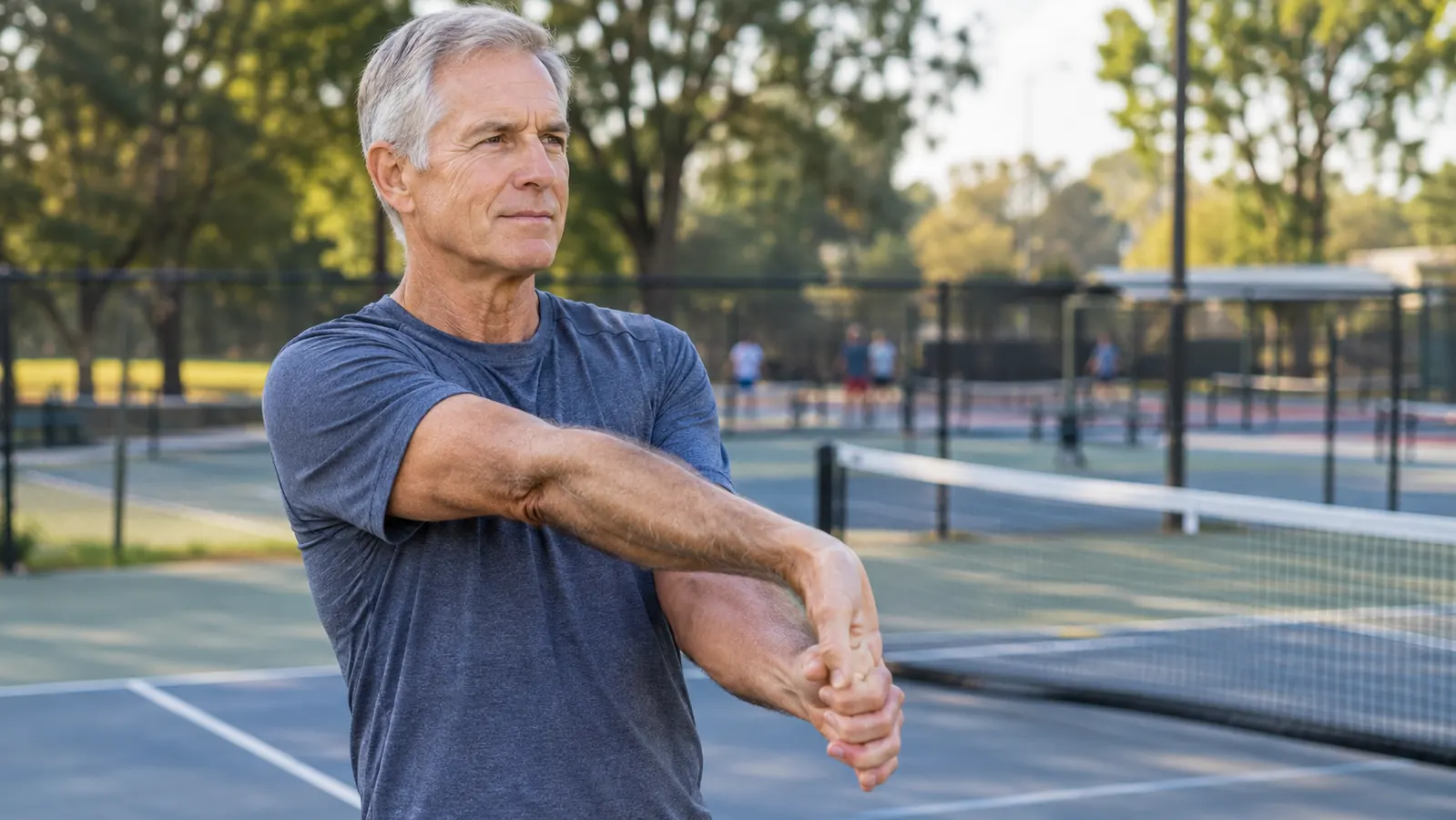
I used to walk onto the court, do two quick stretches, and start hitting. That was exactly wrong. The muscles that attach at the elbow need blood moving through them before you ask them to absorb thousands of impacts. The single best change I made was adding a five minute warm-up that starts before I even pick up a paddle.
Here is what I do now. First, I squeeze a soft tennis ball or a grip trainer for thirty seconds per hand, then release. I do that twice. Then I hold my arm out straight, palm up, and use my other hand to pull my fingers gently toward me until I feel a stretch along the underside of the forearm. I hold it for twenty seconds and switch arms. Then I do the same stretch with my palm down, which hits the top of the forearm. Finally, I shake my arms out like I am trying to fling water off my fingers, and I do a few slow shadow swings with no paddle in my hand.
This is not fancy and it is not fast. It takes five minutes. But it cut my first-game soreness by a noticeable amount within two weeks. My wife Linda, who also plays, started doing it with me and her shoulder feels better too. The warm-up is the cheapest fix in this whole article and it is the one most people skip.
Step 2: Check the grip, not just the weight
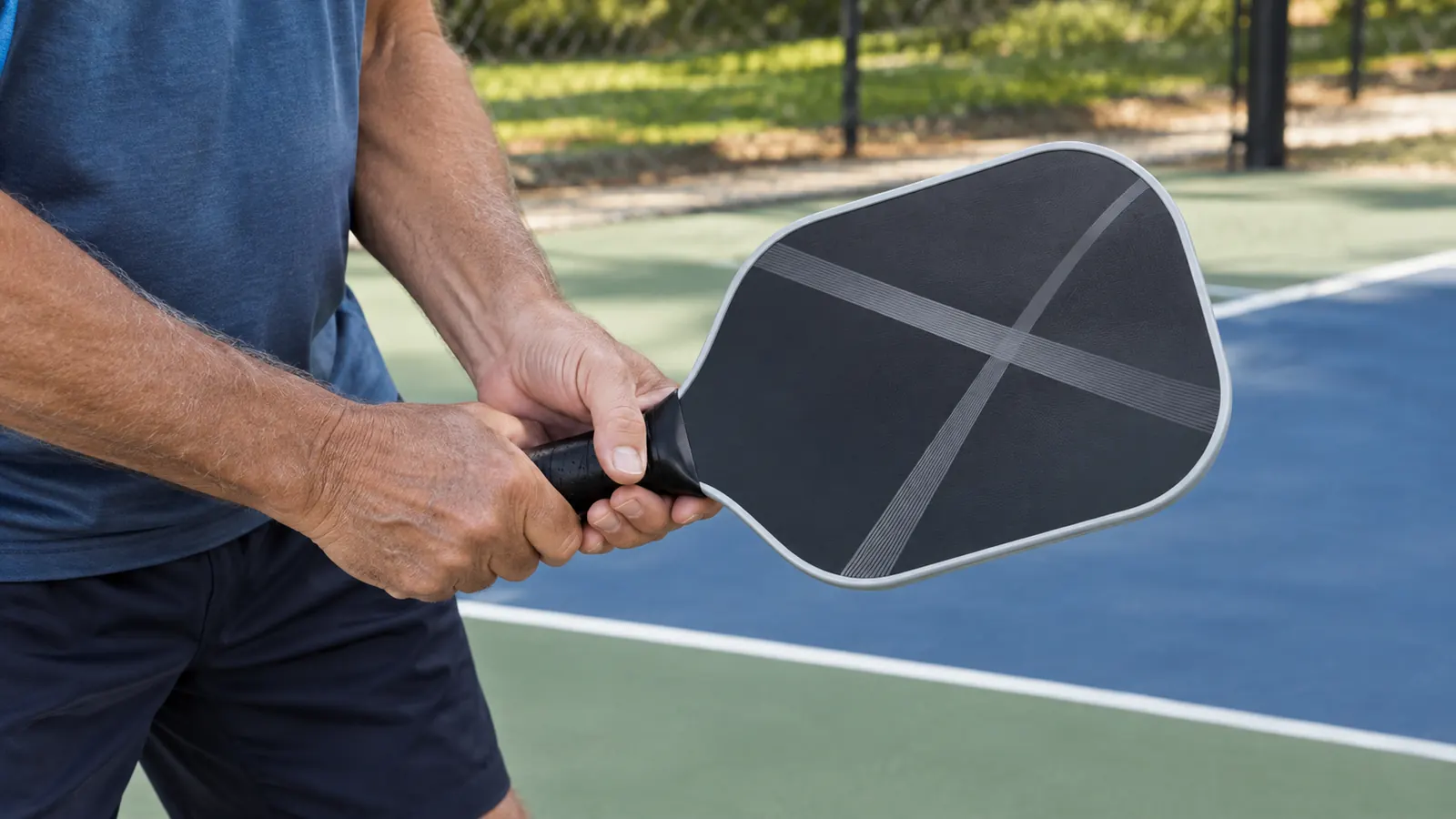
Most players blame the paddle weight when their elbow hurts, and weight matters. But grip size matters almost as much, and it gets ignored. If the handle is too small, you squeeze harder to hold on, and that constant gripping loads the forearm muscles that attach to the elbow. If the handle is too big, you cannot relax your fingers at all, which is the same problem in a different direction.
The Selkirk Sport Neo handle is a standard size, which is a good baseline for most adult hands. It is not a thick ergonomic grip and it is not a skinny junior grip. When I hold it, my fingers wrap around with a little room to spare, so I can keep my grip loose between shots. That loose grip is the whole point. You want to hold the paddle like you are holding a bird that might fly away, not like you are squeezing a hammer.
Try this at home: hold your paddle and relax your hand until the paddle almost slips, then tighten just enough to keep it. That is the grip pressure you want during play. If your current paddle forces you to grip harder than that, look for a handle that fits your hand better before you spend money on anything else. The Selkirk Sport Neo is a good reference point because the standard grip does not add any extra strain.
Step 3: Let the paddle weight do the work
Here is the physics that took me too long to learn. A heavier paddle does not hit the ball harder for you. It just makes your arm work harder to swing it, and every one of those extra ounces gets paid for by the tendons at your elbow. A lighter paddle lets you swing the same speed with less muscle tension, which means less load on the sore spot.
The Selkirk Sport SLK Neo is a lightweight paddle. I do not have a lab scale in my garage, but the difference is obvious the first time you pick it up. My old paddle was a heavy entry-level model, and switching to the Neo felt like someone had hollowed out the handle. The first week, I kept expecting to lose power. I did not. The ball came off the face about the same speed, and my elbow was less angry after a two hour doubles session.
One honest note: light paddles transfer more vibration to your hand than heavy ones, because there is less mass to absorb the shock. If you hit the ball off the sweet spot, you feel a little buzz. For me, that buzz is nothing compared to the constant tug of swinging something heavy. If your elbow is very sensitive to vibration, you can pair a light paddle with a padded grip or a small dampener, but try the paddle by itself first. Most people adapt within a few sessions.

Step 4: Change the stroke, not just the gear
A lighter paddle only helps if you let it change how you swing. The mistake I made for months was swinging the Neo exactly like my old heavy paddle, with a big muscly arm swing and a tight wrist snap at the end. The wrist snap is the worst thing for tennis elbow. Every time you flick your wrist hard at contact, you yank on the tendons on the outside of your elbow.
What works better is a compact stroke that comes from your shoulder and your legs, not from your wrist. Think of the paddle as an extension of your arm. Keep your wrist fairly firm, not locked, and let your shoulder rotate through the shot. On ground strokes, bend your knees and step into the ball. On dinks and resets, use a short push, not a snap. The ball does not care how pretty your wrist looks. It only cares where the paddle face is at contact.
I practiced this in my driveway with a portable net for about ten days before I trusted it in a game. I would hit fifty balls with the old swing and fifty with the new one, and my elbow told me the difference by the end of the week. The new stroke felt weaker for the first two days, then it felt normal, and the soreness after play dropped off. If you have played pickleball for years, your swing is deeply grooved, so give yourself at least two weeks of intentional practice before you judge it.
Step 5: Treat the elbow after you play, not just before
What you do in the hour after you leave the court matters as much as the warm-up. I used to go straight from the car to the kitchen and stand over the counter eating lunch. Now I spend ten minutes cooling down, and my elbow is noticeably better the next morning.
The routine is simple. After the last game, I walk for five minutes to keep the blood moving. Then I do the same forearm stretches from Step 1, holding each one a little longer, about thirty seconds per side. Then I ice the outside of my elbow for ten minutes, usually while I sit on the bench and watch the next group play. If I am at the rec center, I use a cold pack from home. If I am at the park, I use a bag of frozen peas wrapped in a towel. It does not need to be fancy.
The other half of recovery is the off day. I do not play pickleball seven days a week. I play four or five mornings, and on the other days I do light resistance work for the forearm: wrist curls with a two pound dumbbell, reverse wrist curls, and a few farmer carries with a light weight. That sounds like the opposite of resting, but the research and my own experience say the same thing. A tendon that is loaded gently and progressively gets stronger. A tendon that is only rested stays weak and hurts again the next time you play.
The lightest change I made was the paddle. The most important change was the wrist, and it cost nothing.
What Else Helps
A few smaller things made the whole system work better. First, check your paddle grip tape. The Selkirk Sport Neo comes with a comfortable grip, but after a year of play it wears smooth, and a smooth grip makes you squeeze harder. Replace the grip or add a thin overgrip when it starts to shine. Second, pay attention to the ball. A cracked or waterlogged ball vibrates more and sends that vibration straight to your elbow. The Selkirk Sport set includes two balls, and I replace mine when they show a crack, not when they stop bouncing. Third, consider a compression sleeve for the elbow during play. I was skeptical, but a snug sleeve worn for the first hour of a session keeps the joint warm and seems to cut down on the sharp twinges. Fourth, warm up the shoulder too. A stiff shoulder makes your elbow work harder, because the shoulder is supposed to carry the swing. Five arm circles each direction before a game takes ten seconds and it helps.
Finally, be honest with yourself about your play schedule. Two hours of competitive doubles five days a week is a lot for a 64 year old elbow, no matter what paddle you use. I still play four or five mornings, but I take one of those mornings as a light drill session instead of full games. I hit balls against the portable net in my driveway, work on the compact stroke, and my elbow gets a day of low impact practice instead of another day of hard rallies. The Selkirk Sport Neo is light enough that even my drill sessions feel easy on the arm, which is exactly what I wanted when I bought it.
A lighter paddle is the easiest first step, but only a step.
The Selkirk Sport SLK Neo set gives you two lightweight paddles, balls, and a bag for about what some players pay for one paddle. Pair it with the warm-up and the wrist change, and you give your elbow a real chance.
Amazon Check Today's Price on Amazon →